Saturday, October 1, 2011

WINTER MOORING IS IN

The sun setting against the snow dusted mountains.
Two adult and three juvenile Barnacle Geese (Branta leucopsis) forage for their final meals before migrating south this week.
The week started like most weeks now, with Norwegian class.  Anders had the flu, so Nicole stayed home.  I went to UNIS to follow up on a few things and also found out the ship was coming back Wednesday and not Tuesday.  Schedules are always fluid here so having alternative plans is always a good thing.  It had been foggy all day on Sunday, so I used the afternoon to take a tour with my parents around the area.  They really enjoyed it and we saw a number of birds species and some Svalbard reindeer.  I was surprised to see any given that there has been an outbreak of rabies in the immediate area.  We also saw the pink-footed goose and barnacle geese.  The goose species were in the lowest part of the valley feeding on the remaining vegetation.  Later on this week (Thursday and Friday) there was an exodus of these species south, with the characteristic “V” shaped pattern and significant chatter in the air.  The day wrapped up with my parents treating us to dinner at Kroa.  We had not been out to dinner since arriving, so this was a treat for all of us. 
A Svalbard Reindeer calf sporting newly emergent and bloody antlers.
Tuesday morning Nicole and I had a great breakfast with my parents at the Radisson Hotel overlooking the fjord. I think I went up to the trough 3 times! It was off to UNIS for a few hours to get ready for the ship the following day and then took the opportunity of good weather in the afternoon to hike up the glacier with my dad. He did pretty well and enjoyed the fossil hunting he had read about on the blog posts before his arrival. We also finally saw some Svalbard rock ptarmigans on the trip. The adults were already sporting their winter plumage. We had my parents over for dinner that night and played a few rounds of the word game Bananas.

My dad foraging on the glacial morane .
Rocks here are like works of art.


Svalbard Rock Ptarmigans (Lagopus muta; adult above).

Picture of the week: Sunrise

Coast guard vessle and Helmar Hanssen
I stood up early (that is the way it is said here) on Wednesday and after catching a great sunrise, walked down to UNIS grabbed a survival suit and the items requested from the research ship Helmar Hanssen, newly named after the ice pilot of Amundsen’s polar voyages.  I waited at the docks until a zodiac was launched.  It was low tide, so the zodiac’s propeller hit the bottom about 300m offshore.  I waded to the boat with the survival suit on, jumped in and motored to the ship.  The crane hoisted us up in the boat onto the deck.  After greeting a few people, I went to the electronics room to get the equipment ready for the mooring.  After moving to the location chosen because of the data from the REMUS, we deployed the mooring.
Getting the sediment trap ready to add to the mooring line already in the water on the left.
The floats are the final part of the mooring and will sit at 25 meters until retrieved.
 
Depiction of mooring in Aventfjorden.
CTD measures temperature, salinity,
while the sediment trap measures the
amount and type of particles raining out
of the water column. The ADCP is an
acoustic device used to measure
zooplankton.  The acoustic release at
the bottom is triggered at the end of the
experiment, sending the entire mooring
to the surface for retrieval.
The mooring, as described in earlier posts, is comprised of a weighted line with a set of instruments on it.  This mooring will measure variables (temperature, salinity, zooplankton, chlorophyll, and sedimentation) over the winter season.  For the electronic sensors, they will take measurements every 20 minutes and for the sediment trap once a week.  As the mooring is fixed in one position it will collect a data at the particular depths to see the changes over time.  We are examining the influence of North Atlantic Water (NAW) in the fjord system.  The strength of the NAW (a remnant of the Gulf Stream) modulates the timing and amount of ice in the local area.  It also brings a number of unique species into the Arctic.  This system is being closely monitored as it is a large scale feature that is an integrated climate signal of the Atlantic.  Colleagues at UNIS have been deploying these moorings around Svalbard for the past 6 years and are beginning to see trends beyond the seasonal signals.  The influence of the NAW brings significant amounts of heat to the system and is a major reason that the local fjords have not frozen over in recent years.  The specific purpose of the mooring we put out in Adventfjorden is to establish whether it is representative of conditions in the center of Isfjorden.    The other reason is that we needed a station easy to get to from Longyearbyen in the winter as we are going to be sampling that position for water samples and with the REMUS. 
The deployment went well and after we cut the line sending it to the bottom, we headed for the docks.  There were about 40 people on board and a number of them woke up after I had arrived, so they were wondering who this new person on the ship was.  I was able to get off the ship at the fuel docks and walk back to UNIS.  I met my parents for lunch in the UNIS cantina before they headed for the airport.  It was great to have them here for the 5 days.  In the afternoon, I worked with the PR person at UNIS on the helicopter story, which was released on Friday (click here forthe link). 
Side scan sonar image of the Bell 212 helicopter at 70 meters depth in Adventfjorden.  The portion on the left is the main section. On impact the tail broke off.  You can see in the upper right inset a picture from the crash report the tail section laying on the sea ice to the right of the hole that the helicopter sunk.  In the sonar image the placement is exactly the same. The rotor blade also came off and stuck into the sediment like a knife.  This is clear in the sonar image as it casts a long shadow on the seafloor (the REMUS was imaging from the right). 
Thursday was another solid work day (papers, emails, data).  I received the bioluminescence instrument and started to find the power source, cables, and software to run the instrument.  Bioluminescence is a chemical reaction that occurs in a number of marine organisms.  Previous work that we did here last year, showed that bioluminescence was present in the polar night.  I have also been able to show that you can separate the signal and distinguish different groups of animals using the intensity of their flashes.  We are going to be deploying the instrument off the docks until the middle of winter to show the transition from light to dark. Usually, there is a biological clock that turns bioluminescence on in the absence of light, but no one has documented this over this time in Polar Regions.  We are also going to use it to look at difference groups of plankton around the mooring.  I wrapped Thursday up with a couple hours of basketball.  The team is not only getting better, it is getting bigger.  We now have 17 players when we started with 11. 
Sunset behind the power plant.
Norwegian lessons started Friday and the rest of the day was at UNIS finishing the final edits on two papers we hope to submit, contributing to a proposal and continued work on the bioluminescence instrument.  The day was significantly colder with light flurries… it has started!  Next week,  I have visitors from the Norwegian University of Science and Technology’s Applied Underwater Robotics Laboratory in Trondheim to discuss charting Norway’s course in robotic applications in the Arctic.  I spent part of the day working on the logistics to get conference rooms, coffee, etc. organized.  Walked up the hill after the busy week and was pretty happy with the accomplishments. After pizza and the new Transformers movie (set it up so we can view movies on the computer through the TV), we all slept well.
A snow flurry constrasts the rugged geometry of a mountain on the other side of Isfjorden.

The ray of the setting sun lights up the fresh snow.
Today was a day to sleep in a bit and recharge the batteries.  Anders went to a secret agent birthday party next door and we cleaned the house, did laundry, I did the bills, and later went grocery shopping.  Nicole is feeling a bit under the weather, so it was good nothing was planned.  Jason is spending the night at a friend’s house blissful with their addiction to a newly found computer game, Minecraft.  Anders, Nicole and I played a game of Settlers of Catan (Anders won) and it has been nice just interacting with him tonight.  Today and tonight is our first major snowstorm of the season and we are warm and cozy in our apartment.

Sunday, September 25, 2011

TRANSITION TO WINTER

Frost crystals mark the arrival of winter.
A lattice of ice forms over a tundra stream.
It has been a full week of activity.  I had to skip Norwegian (and my first test) to teach at UNIS on Monday.  It was the Arctic Biology class for undergraduates.  They were on a cruise in August around the island group collecting data on the physical oceanography, light penetration, marine plants, zooplankton, the diversity on the seafloor, and the abundance and diversity of fishes.  They are now battling the task of wading through all this data to write up a group reports on the subjects mentioned above.  I have taught a number of courses on science writing and took on the task of helping these groups develop their data, and make the transition from reporting what was done to enhancing their understanding of the science.  I took four 1-hour lectures and working group discussions to start the process and convey the instructor’s expectations.  Although some of the students have had experience with data analyses, it was quickly evident that I had to start from the beginning.  They will be using me as a resource from now until their reports are due in November.  It was good to meet the students formally and get a sense of their areas of interest.  They were interested in my work here, so I plan on taking them out on the water when possible. 
Teaching Arctic Biology at UNIS.
Tuesday I was able to get on the water with the REMUS and conduct a pre-survey of the area planning for the mooring installation.  Nicole came out with me and it was good for both of us to be on the water.  Even though I have made close to 300 deployments, this was the first time Nicole has seen the process.  I had first met Nicole in the Antarctic working from small boats, so this was like rewinding the clock 18 or so years.  The data showed that there was significant variability at small scales in the center of the fjord and helped us understand the influence of tides in the area.  This and profiles of the density in the area provided the information needed to identify a good location for the winter mooring. 
Nicole warming up with a cup of coffee while the REMUS roams under the boat.
Wednesday started with Norwegian and it was good to be back in class (I had missed the last three classes because of travel and teaching).  They had jumped forward, but I was able to catch up.  It was a beautiful day, not a cloud in the sky and no wind.  Because the sun is now so low on the horizon at noon (about 11 degrees), it has to be clear to get direct sunlight.  Although there was a pull to address my continually expanding list next to my computer, the weather won and I took about 4 hours to walk up the glacier.  It was a little below zero and the frost on the plants and rocks was a change from previous excursions.  It was the fall equinox, so fitting that this was the day that marked a change in the weather and the transition to winter.  The hike was amazingly peaceful and reminding me how fortunate we are to experience life at the top of the world. 
Frost covers remaining vegitation in the valley.
A white sheen covers the rocks on the path up to Longyearbreen.
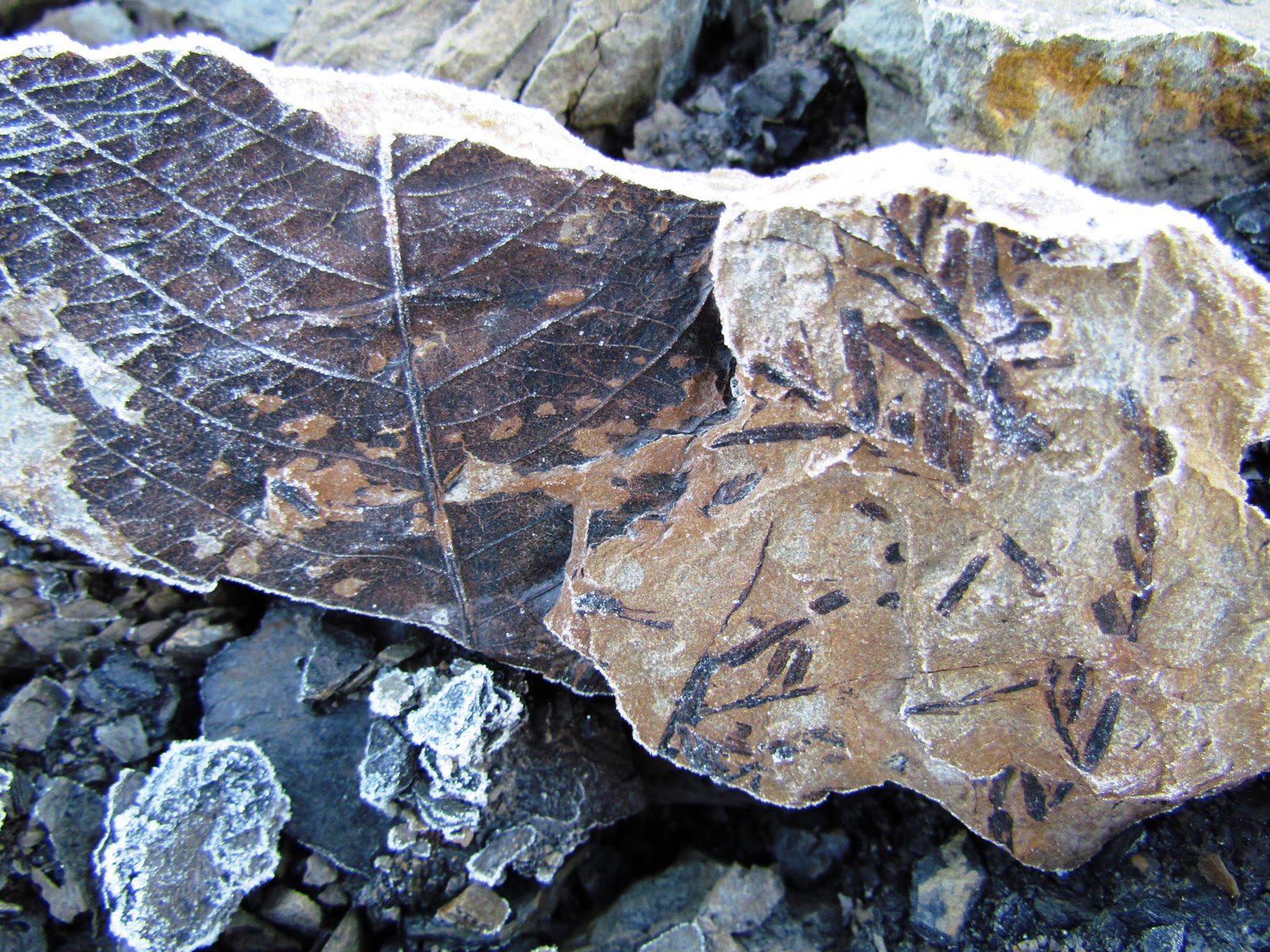
Frost collects on the ancient leaf veins.
At about 3pm local time the sun streams down the glacier towards Longyearbyen.
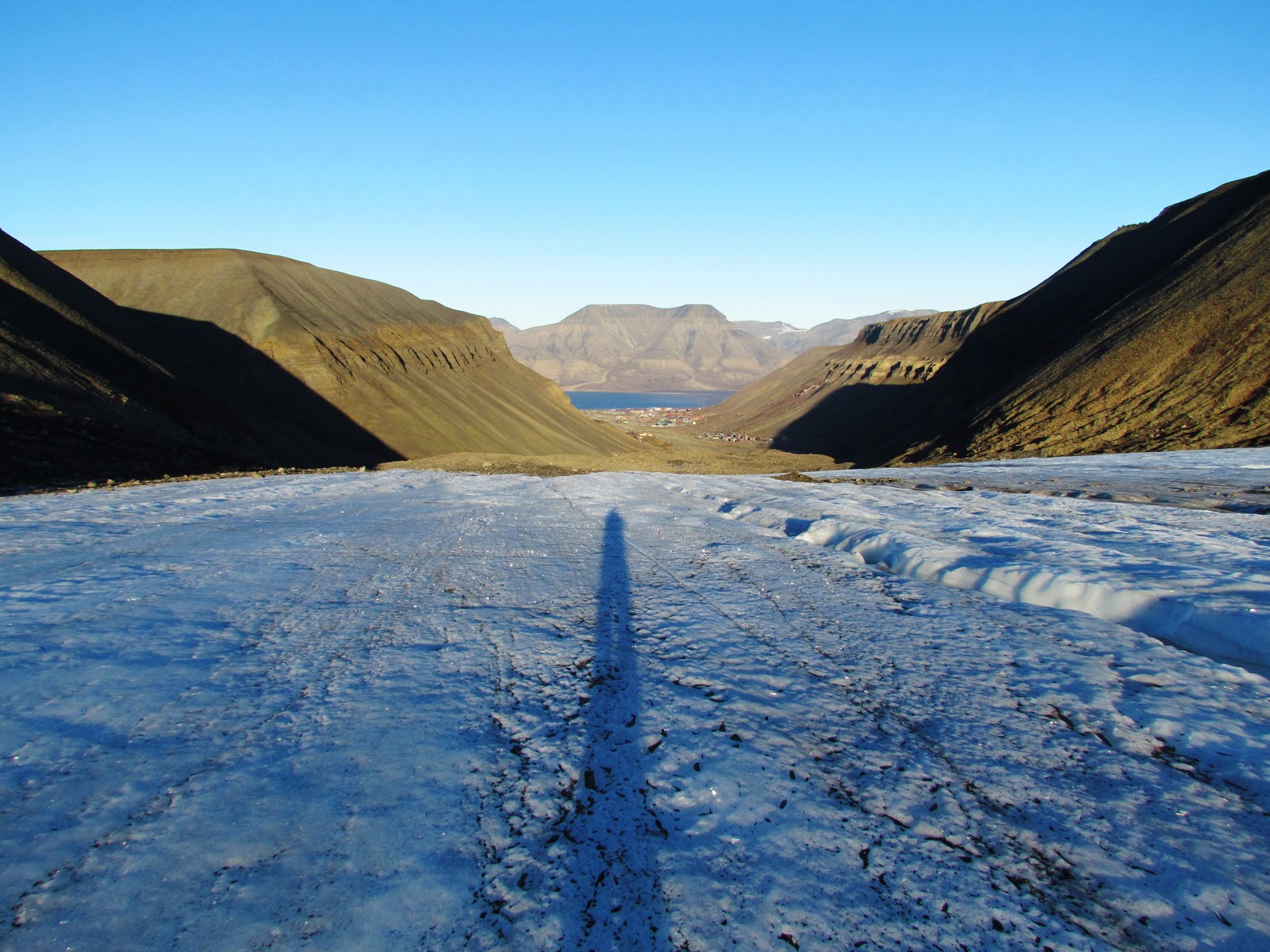
Picture of the week: Long shadow is cast toward Longyearbyen on the fall equinox.
Unlike the summer, the fossils are now frozen into the ice-mud matrix.
New mine 2, also known to the children as Santa's House lit up in the afternoon sun.
An ancient leaf once again absorbs the sunlight.
Ice crystals cover a fern and begin the winter's dormancy.
The rest of the day I worked up the previous days data and also planned a mission for the following day.  Nicole was great to come back out on Thursday and help out with the REMUS.  We collected addition profiles of temperature and salinity for understanding the dynamics around the fjord.  We also happened on a helicopter at 70 m depth that had crashed in 2003.  The vehicle has a side scan sonar, so can image the sea floor using sound.  Pretty cool… We are writing up a story for the local paper on this for next week (I will post the photos then).   Thursday evening was my second session with my basketball team.  We scrimmaged for the hour and I saw some real improvement and promise in the team.   Jason also started his junior rifle shooting class and loved it.
Adventfjorden on Thursday while deploying the REMUS with Nicole.
Friday morning like Wednesday was working up the data and talking to a colleague about the sampling approach in and around the winter mooring before she left that day to the mainland.  In the afternoon, I went to the airport to pick up my parents who are visiting for the next 5 days.  While there, I bumped into Jason’s teacher, someone who works at the only grocery store and someone I know from UNIS.  It is a small community and I am becoming more and more a part of it.  I was also the benefit of an outbound passenger who didn't understand the carry-on liquid rules.  He ended up giving me his entire liquor purchase in Svalbard. Score! My parents arrived safely and I brought them to their hotel.  Their room was upgraded and it has a great view of the fjord.  I gave them an hour to get settled while I went back to UNIS to finish up a few things.  After Jason and Anders returned from the sled dog camp and football, respectively, we had a great dinner with the family and opened the requested items from the US… mostly food.  It had been 6 months since the family had seen them so it was good catching up.
The family at the dinner table with my parents.
We spent most of the day with them Saturday, visiting the museum, giving them a tour of UNIS and showing them the “downtown”.   I hadn’t visited the museum in all my trips to Svalbard, so it was nice for me to see.  Given the space, it is a very impressive museum covering the geology, human history, the arctic food web, and the current scientific efforts to further understand the area. 

In the afternoon, I headed to the sports turn to play our game against Barentsburg.  The entire day had been a sequence of sporting competitions and now it was basketball.  The age of the Russian team was about 10 years older than “mine”, but in the pregame talk, gave them strategies to overcome this.  We were ready to go and started the game.  We jumped ahead on the scoreboard as I had put our best team on the floor.  I had planned to put myself in later when substituting some of the beginners.  Within 5 minutes it was clear the referee did not know the game as he was not really calling anything.  Both teams were getting upset, so in order not to make this a completely awkward situation, volunteered to take over.  With no objections from the Russian team, the organizers or the ref himself, I reffed the rest of the game.  While we were ahead most of the game, but a series of missed layups and two 3-pointers by the Russian team cost the game by 3 points.  I had really wanted to play, but given it was a fairly charged energetic game, it was good I was in a position to keep things calm. 
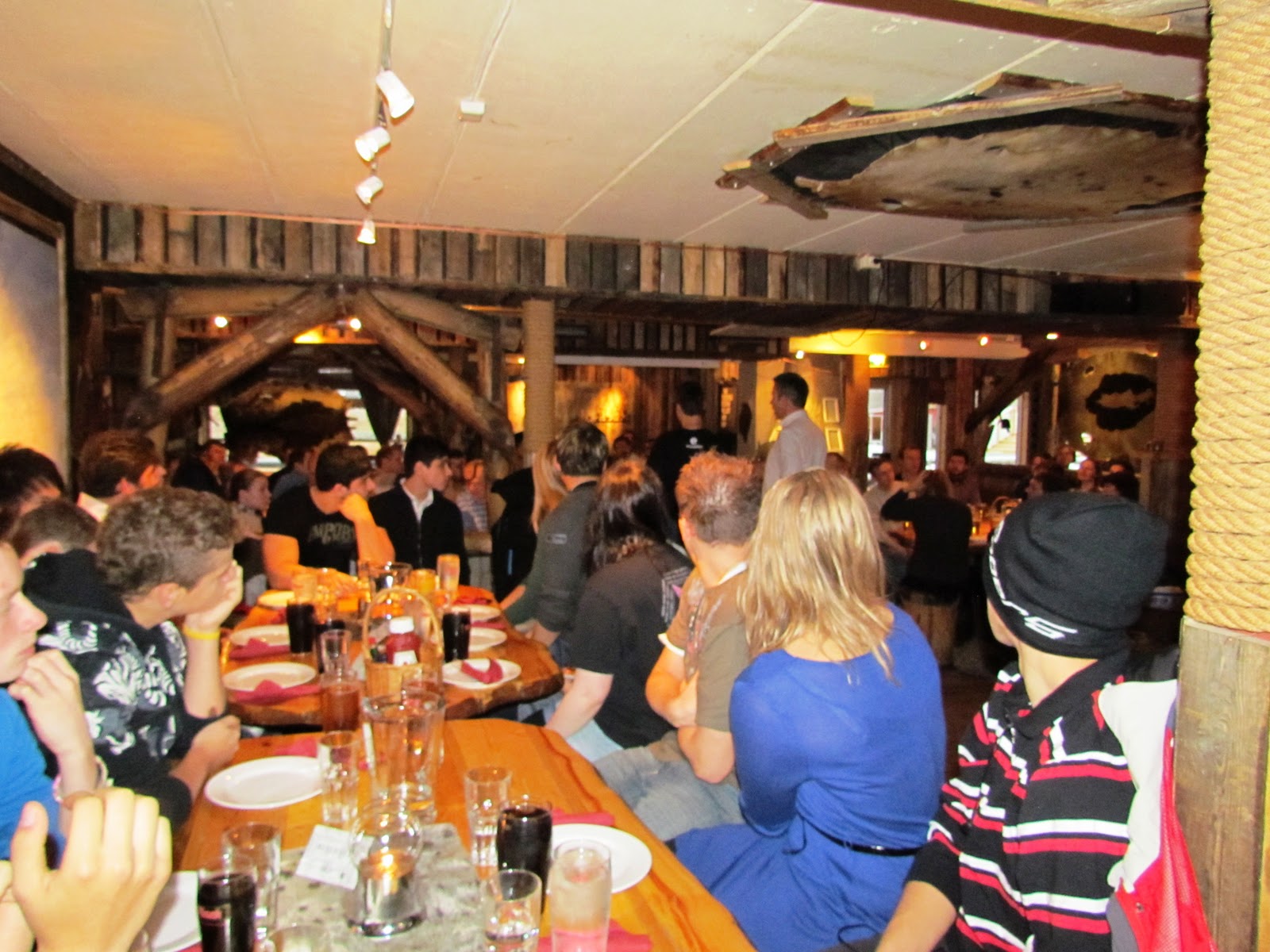
The sports teams of Longyearbyen and Barentsburg at Kroa restaurant for awards and pizza.
Spent some time at home before heading to the Kroa restaurant where all the sports teams from the day with Barentsburg met for pizza.  There were formal introductions, the exchange of gifts and words of cooperation and then we all feasted on pizzas… no I am not going to say how many pieces I ate!  I sat with our team and it was good to meet a few of the players more.   I found out a number of the team members are related, some from Serbia, grades they are in and where they worked in town.   After eating, Norway presented awards to the best Russian players for each of the sports.  The rest of the night was spent at home catching up with my parents before dropping them off at the hotel.  The annual Octoberfest beer festival is here now, so we had to wade through the brats, beer, lederhosen and the pig on a spit to get them to their room. 

We woke up to a sugar coating snowfall on the surrounding mountaintops and a cold misting rain.  I had hoped to take my dad up to the glacier for fossil hunting, but it was not to be.  Anders also had a stomach flu, so it was a good day to stay indoors, get caught up, play games and replenish the batteries.
Mid-morning sun in Adventdalen.
Colors blanket the fjord and the old coal crane.

Sunday, September 18, 2011

HELLO TRONDNHEIM

The lights in town are coming on as the sun is rapidly lowering on the horizon.  On the left is the power plant stack, with the airport in the background and the docks busy offloading cargo in the foreground.
The week started like a normal week with kids getting ready for school and then off to Norwegian class with Nicole.  After learning some new sounds and the words to describe the weather and the family (mother, brother and so on), I headed to UNIS.  I touched base with a few colleagues on the REMUS work while they were on the cruise.  The goal is to map the area around a mooring (a string of automated instruments on a vertical line in the ocean) with the REMUS so that we can characterize the best location.  I will obtain the data and then send it to them on the ship and we will install the mooring on the last 2 days of the cruise.  At least that is the plan!
 
Looking out over the fjord in Tromsø
Looking back at Tromsø on the way to Bodø.
I then got a ride to the airport (always nice not having to take the bus!) and caught a flight to Trondheim.  We are now down to one flight a day (no Saturday flights), which arrives at about 1400 and leaves an hour later. There are also no direct flights to Oslo, so all flights are routed through Tromsø.  I had a three hour stop-over, so I was able to get out of the airport and walk around a bit.  It had been cloudy and rainy since leaving for Stavanger the previous week, so walking in the sun was a good thing.   We then flew to Bodø watching the sun set and after 40 minutes on the ground headed for Trondheim.  I caught the bus into town and arrived at my hotel at about 2200.  I stayed in a hotel on the main river though town, elv Nidelva, which had opened only 4 weeks ago…very nice. 
A view of Trondheim looking up the Nidelva River.  The colorful houses used to be warehouses for fish and commercial traffic in and out of the Trondsheimfjorden.  In the background is Nidarosdomen, dates to 1000 and burial place of Viking Kings and St. Olav.
The next day, I went to the Norwegian University of Science and Technology (NTNU) and met some colleagues and talked about new marine initiatives in Norway. That night everyone had something to do, so I was on my own.  It was good to relax a bit ad catch up on some papers that I am writing.  The next day I gave a talk on nested technology approaches in addressing scale in the ocean to a group from Statoil (the national oil company) and NTNU.  The basic idea is that the ocean is dynamic and depending on the process of interest operates on varying time and space scales.  How to optimize sampling to address these processes (i.e. fisheries, pollution etc.) is a difficult problem and approaching this with a set of platforms (i.e. AUVs, moorings, and ships) instead of just ships for example is a better way to do that.  I showed some applications of this approach and generally got a good reception.  Then I was off to NTNU’s biological station, a beautiful renovated historic building on Trondheimsfjorden overlooking Trondheim. That night I had pizza with a colleague and his family before heading back to the hotel. 
Above: Infront of NTNU's Biological Station which was established in 1900, three year's before Scripps Institution of Oceanography and 30 years before Woods Hole Oceanographic Institution.  Below: On the peir of the station with Trondheim in the background.
On Thursday, I went to visit the Department of Nature management.  They are interested in a summary of underwater techniques to map and monitor seafloor habitats and organisms and I talked about the different approaches with optical and acoustical instrumentation.  After some additional work at NTNU, I headed to the hotel before going out for dinner.  Dinner ran late that night (0130), so getting up at 0430 was a bit brutal.  The flight back was a reversal of the way here and I slept most of the trip back. 
On arrival, I stopped by UNIS and touched base with the leader of an undergraduate class that I will be teaching next week to coordinate plans.  Then it was home… yes… it feels like home now, took a nap for a couple of hours and then we went to our friends house for dinner.  We filled ourselves on Tacos, had some good conversation and played a US versus Norway match in Wii.  The kids had a great time and it was good to be back with the family.
The mountains get a powdering as the temperature begins to plummet. 


This weekend was beautiful with a rare cloudless day on Saturday and mostly sunny on Sunday.  The temperatures have noticeably dropped and are now hovering around freezing. Unfortunately, I had to use most of Saturday revising a science manuscript (due Monday), but I got it done!  Today, I went to UNIS to finish up my lecture for tomorrow. Home for lunch and then went to the gym with the family.  Nicole and the boys went swimming while I played basketball.  I was asked to coach the team, so after shooting around a bit, I started on some of the basics.  It is an enthusiastic group with little experience, but I think we can get somewhere.  We have a game with the Russian coal mining settlement, Barentsburg, next week, so it should be interesting.  I am writing this now before heading to football tonight and then start another busy week… Looking forward to being in Longyearbyen for a while. Time is flying by!
Picture of the week: The low sun fills the sky with orange and reflects off Adventdalen's river.

Saturday, September 10, 2011

HELLO STAVANGER

Picture of the week: REMUS starts moving after being launched in Adventfjorden.  A blue ribbon of smoke from the Longyearbyen power plant follows the contour of the coastline.
This week started with the first deployment of the REMUS AUV.  When planning the mission, the first objective was to calibrate the compass.  This happens by driving it at the surface in two large circles so it can “see” all the compass headings (0-360 degrees).  After that it knows the magnetic field and adjusts the compass accordingly.  This close to the north pole, the magnetic compass is significantly different than the geographic headings, and therefore the calibration is very important.  The vehicle run was done with a colleague from NTNU in Trondheim, Geir Johnsen.  We went out at about 20:00 and the winds were calm and the fjord glass...perfect conditions!  The objective after the compass calibration was to simply drive the vehicle up and down in the water column across the fjord and back.  We lifted the vehicle out of the boat into the water and sent the acoustic start command and it conducted its mission flawlessly, coming up the surface occasionally for a GPS fix.  We had a period of nervousness when a large cruise ship passed us as the vehicle was heading back, but the time to cross paths was off by 5 minutes. 
REMUS doing its circular compass calibration with Avdentdalen in the background.
Enjoying a cod roe sandwich that Geir made while tracking the REMUS... and driving.
The next day after a hectic morning at UNIS I flew to Stavanger in the southern part of Norway arriving at 22:00.  I was invited to give a talk and contribute to a discussion on AUV technology, so had spent last week putting the talk together.  The workshop went very well and learned about some of the applied challenges for AUV operations in Norway.  We had an amazing dinner on Wednesday night starting with champagne and caviar and ending nine courses later at 01:00.  The following day we all met again to summarize the discussions and document some next steps for the group.  I left that evening for my return voyage back to 78 degrees north.  The flight from Oslo to Tromsø and Tromsø to Longyearbyen was amazing as we were continually chasing the sun setting with the hues of violet to deep red on the left side of the plane.  I caught a cold on the way back, so work on Friday was a bit difficult, so I stuck to more housekeeping duties. 
Stavanger is the oil capital of Norway bustling with offshore activity (here a foot of an oil rig).

In a side meeting at the top of the hotel overlooking Stavanger with Asgeir Sørensen, head of the NTNU Applied Underwater Robotics Laboratory in Trondheim.

It has been a long week for everyone, so Saturday has been a day to relax, clean the house, give Nicole a break, play a few board games, and for the boys to do their homework. 
The Sun is rapidly setting; now at 10:30 and rising at 3:30 with amazing colors throughout the night... still no complete darkness.

Sunday, September 4, 2011

SNAKKER DU NORSK?

The colors are starting to come out with the setting sun.
This week that saw the advancing darkness, Nicole and I started our Norwegian class.  It is MWF for 2+ hours in the town school.  There are 12 of us, with 6 different languages between us.  Just the routine and the repetition has been very helpful and both of us have noticed an improvement in our pronunciation and understanding.  The time out of the morning work schedule is an adjustment, but it is good to spend more time with Nicole.  It is also at the school, so we also get to embarrass Jason and Anders occasionally. 

My colleagues at UNIS were gone on the student cruise this week , so it was a good time to push at work.  I was able to finish revising a manuscript, review another and finish the presentation that I am giving next week in Stavanger.  Also found out our work from Svalbard will be published in the journal Marine Biology, so we were all excited about that. I was also able to wrap up the logistics at UNIS and get a dedicated boat for the rest of my stay.  Friday I was able to get on the water for the first time and conduct a fjord survey, making sure of locations of land and underwater features that would interfere with the operation of the REMUS AUV.  Cara Magnabosco helped me out in the field.  She is a student Fulbright Fellow here at UNIS, who I met at the orientation in Oslo, and was available to help out.  I hope to get a number of students out with me during the Fall. 
Cara Magnabosco, a Fulbright Fellow joined me on the first outting with the boat in Adventfjorden.
The 3 boys started activities this week with Anders playing football twice a week (seems to love it) and Jason enrolled in the dog sledding course.  The picture below tells you whether he likes it.  I also started senior (17+) football three times a week.  This week I played on a team with 5 Chileans, so it was the America’s against Europe… we won 8 to 5,  however very little was because of my brilliant play.  As the oldest there, I did pretty good keeping up.
Jason started his sled dog care and mushing class.
Saturday the family took a tour to Pyramiden, a former Soviet/Russian coal mining settlement about 70km further up Isfjorden.  The trip was with a family from town we know, so the kids had others to occupy their time.  We were fortunate that the water was calm and it was smooth trip.  Arriving at the settlement was eerie as there was a thick fog.  There used to be 3000 people living there in the 70’s and given the size of the place and the quick exit (when evacuated people living there only had 3 hours to leave!), you could still imagine the activity.  We were able to enter the Cultural House, the Swimming Hall and the Hotel.  The other buildings are locked, but in the same state they were when everyone left 17 years ago minus the wear of the extreme climate.  We were welcomed back to the boat after a two hour walk around the settlement with a whale BBQ…tastes like beef with a hint of liver from the high hemoglobin content.   After Pyramiden, we went to Nordenskiöldbreen glacier at the end of the fjord to see the intense blue from the high pressure of millennia of compacting snow.  The sun popped out on the return trip, which was a boost to everyone (it had been overcast for two weeks now).   Wildlife on the way consisted of a number of bird species, including puffins and fulmars (see picture of the week below), and a sole minke whale… probably running away from the BBQ! We all slept well after the 9 hour trip…
Jason and I enjoying the view from the bridge.
Puffins on the way to Pyramiden.
Lenin greets us at the culture house in Pyramiden.
Inside the theater of the culture house in Pyramiden.
Nicole and Anders relax in the Pyramiden hotel.
Anders looking onto the once northernmost regulation pitch in the world.
Nordenskiöldbreen  glacier
Papa and the boys in front of Nordenskiöldbreen glacier
Picture of the week: Nicole took this awesome shot on the way back from Longyearbyen.
A strip of sunlight illuminates a layered rock outcropping along Skansbukta.
Today we were invited to a christening of Mathea at the church here in Longyearbyen.  She is the sister of two boys that Jason and Anders first met here in July, whose mother is now friends with Nicole.  It was hard getting up and out of the house after the long trip, but we managed and arrived just in time.  The service was simple, a lot of hymns and a nice informal setting.  Although singing is not my forte or my favorite, it was an excellent exercise in helping with my pronunciation…. I could belt out words and everything that was wrong faded into the chorus.  We had a quick coffee, spoke to a parishioner for a while, went home to get the camera, and then headed to the party at the “rifle range hut” overlooking the airport and Isfjorden.  We joined our friends with their extended family that had flown up for the event and had baby reindeer stew (sorry to those that are offended by the traditional cuisine here), salad, rice and Thai egg rolls.  The cook (a Thai that works in a local restaurant) was also invited, so we were able to complement him on the good food.  Cakes followed and then the gifts.  This family has a history in Longyearbyen with 2 generations of coal miners.  As part of this tradition, we all signed a piece of coal with her name on it.  It was a great experience.
Jason enjoying Norsk flatbread at the christening party.
The research ship just returned, so I am going to help them unload etc. and get ready for another busy week…